Attitudes of a devotee
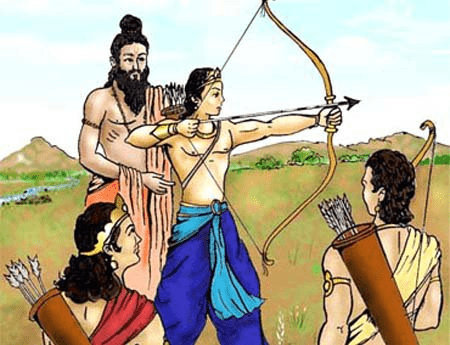
One of the things that people have difficulty with in any new endeavor is adopting for themselves that particular mental state that will make them most likely to succeed in that endeavor. There is a story in the Mahabharata of Dronacharya, who was the teacher in the arts of war of the Pandavas and Kauravas in old times in India. Those were the two who fought each other ultimately in the battle of Kurukshetra, which is the background for the great scripture the Bhagavad Gita. And each one of these students came up and what Dronachara had done was set a vulture in a tree and on a very high tree tied him there and they were supposed to hit the head of the vulture. Not a very nice thing to do, but after all, they were being trained for war, so I guess it’s acceptable. And each one who came up with his bow and arrow to shoot at this vulture was asked by Dronacharya the same question. What do you see? Well, sir, I see the vulture and the tree, and I see my arrow and my bow, and I see you, and all these various things. They thought that they were supposed to be as inclusive as possible. And he said, “Well, go ahead and shoot.” But he knew they wouldn’t hit it. Then Arjuna, who was his prize student, came and he said to Arjuna, “What do you see?” He said, “I see the head of the bird.” Dronacharya said, “Don’t you see anything else?” He said, “No, sir, just the head of the bird.” Dronacharya said, “Go ahead and shoot. I know you’ll hit it.” And he did. This is an example of what is intended, what I mean by the need for the right kinds of attitude, the right attitudes for success in any undertaking.
Sometimes these attitudes are quite false. The undertakings themselves are false. I remember when I was trying to get a new car a few years ago, I was beginning to see the handwriting on the wall even then of this car that I finally got rid of. And no, I haven’t got rid of it. Anybody want to buy a nice Renault but I got a new one in place of it anyway. And these people in the lot where I had my Renault treated. I think that’s about the thing the word you’d say with a patient like that. So the doctors in this carlot urged me to buy a Cadillac, which they said was a really good buy. And I said, “Look, I can’t see myself driving a Cadillac.”
They said “Oh, you ought to try this one. It’s a really fine car and it’s in good shape and it’s very cheap and you’ll never find another bargain like it. “
I said “Well, yeah, but still I just”
They said “Oh, come on, try it.“
So, anyway, I finally got in that car and drove it. And sure enough, the sort of image that I got of myself driving that car was so foreign to everything that I’m interested in doing that even if the car had been 5 cents, I don’t think I could have bought it. One got the image of mink coats and tuxedos and just the sort of self-image of opulence and pomposity and self-importance and everything that goes with being rich in most people’s minds. I say it’s a false attitude, but for some people if they want to make money, they’ve got to think that way. It’s unfortunate, but they get that kind of image of themselves and pretty soon they’re starting to make money because they’re thinking that they’re rich like this.
I’ve known people who were rich who weren’t like that at all. But they were devotees and it was different. One great devotee that I’ll speak of briefly was Rajarshi Janakananda who was James Lynn. He was many times over a millionaire. If you can imagine somebody having a 9-hole golf course for his front lawn in the heart of Kansas City, you figure that he probably had quite a lot of money. But he never thought of himself in that way. We never heard about this 9-hole golf course until about 20 years later, somebody came who had been on sort of a bus tour that tourists took when they went to Kansas City and the bus driver or whoever it was making the announcement said, “Oh, there is the home of this millionaire James Lynn who’s got a 9-hole golf course on his front lawn.” And we didn’t know anything about it. He never talked about his own affairs. This was sort of from before he had met Master, but he never talked about himself. He never talked, he never seemed at all anything but just a humble yogi. He would come into the rooms of the children there or of the farmer who was working on the ground there and he’d sit and meditate and talk in a perfectly ordinary way. And it was not a big thing with him. Money wasn’t a big thing. He simply had the karma to attract it. But he used it for good ends. People in Kansas City thought that he was a nice but deluded person! They heard about his interest in yoga and so on. But at least he seemed like a very nice fellow. So they didn’t know quite what to say. They just sort of tried not to talk about these peculiarities of their upstanding fellow citizen. He was a very important person in the town. He was on the board of directors of all kinds of banks and railroads and this thing and that thing. He owned all kinds of companies, was the president and chairman of the board of them and he just wasn’t able to do anything without making money. It was just he just had that karma. But he never seemed to be that kind of person that you would imagine in that particular meilleur.
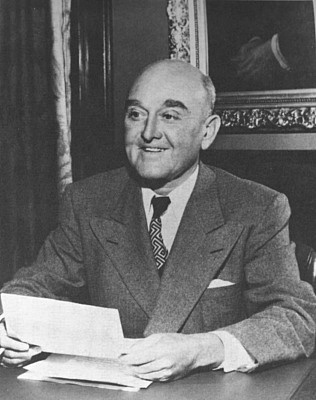
Quite the contrary, he just was like a little child in his business office. He was always just a friend to his employees. If somebody couldn’t work out in some department, he would always try to find another department to put him into. He was a man whom everybody trusted. They just knew that what he said was spoken with intelligence, with wisdom, and without any kind of self-interest. They had so much regard for him that even on these other boards that he was on that he didn’t own the company or anything. Yet he didn’t like smoking. He never said, “I don’t want people to smoke around me.” He simply would leave the room. He respected other people’s right to do what they wanted to. But he himself couldn’t stand it. And so he wouldn’t be around where people were smoking. And they had so much regard for him and so much wish that he work with them that it just was an unspoken rule that nobody ever smoked whenever he was present. No matter who it was, they just didn’t smoke. He would never get embroiled in the various arguments that took place in these directors meetings. He would just sit there quietly, listen and people would get sometimes very heated talking for this issue and opposing that issue and so on. But after all the various things had been said, he would very quietly say, “Well, it seems to me that what we’re really trying to say is so and so.” And always he would put his finger right on the pulse of the argument in such a way that both sides would be reconciled. They would both see yes that’s really what they were all after and the argument would be finished. He had this marvelous knack and yet you know I never saw him talk very much.
He was that kind of person. Very, very childlike whenever he did talk. But normally it would be just that you would be standing and he would see you and very joyfully he would come over and bless you and then walk away and perhaps two words would be exchanged and that’s all or he would just say Master bless you and he’d go on. But it was so beautiful to be in his presence because you felt that here was a person who never took himself seriously, never felt that he was anything except just a child of master and of God.